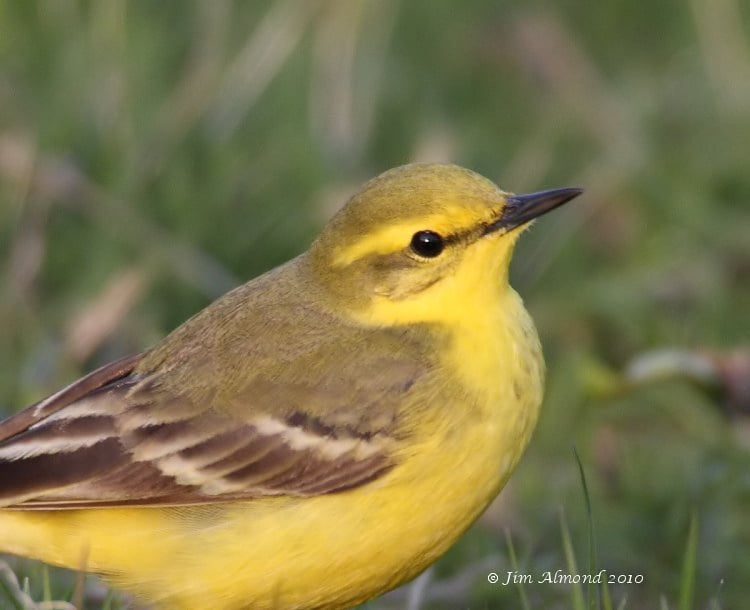
As the Weald Moors area is a Shropshire stronghold for the Lapwing and corn Bunting, so its open, watery landscape is a mainstay for the Yellow Wagtail. At one time, it was most readily associated with wet places but, ironically, the vast crop fields facilitated by the forensic draining of the moorlands have proven equally attractive to this exotic summer visitor… .
ID: a small, slender bird with vivid yellow and green plumage. Superficially similar to the Grey Wagtail, it has a shorter tail and lacks its counterpart’s slate-grey upper body. On the Weald Moors, Grey Wagtails are more notable as a winter visitor, which is a time you definitely won’t encounter a Yellow Wagtail because…
Yellow Wagtails arrive on the Weald Moors from sub-Saharan Africa in mid-March (Jim Almond)
In the Field: Yellow Wagtails spend winter in sub-Saharan Africa, arriving on our shores from mid-March onward. Given its soft spot for the Weald Moors, it won’t surprise you to learn that this is a bird of open landscapes, which often makes its nest (a small grassy cup constructed within a scrape on the ground) in large fields well away from tall hedgerows and trees. On arable land, nesting Yellow Wagtails do not tend to fare well among densely structured autumn-sown crops, requiring more sparsely vegetated open ground in which to search for the insect and spider food that forms the major part of their diet. Consequently, fields of spring beans, potatoes and peas are often popular nesting locations, along with the adjacent tramlines created by agricultural vehicles — where they are highly vulnerable to predation. Yellow Wagtails will also forage for food on grazed pastures, in wet areas free from shading (such as ponds and ditches), and in grass and flower-rich field margins.
The Weald Moors are now a county stronghold for this declining species (Jim Almond)
How Are They Doing? Not very well! Yellow Wagtail numbers have declined by 75% in the last forty years and it is now a red-listed species of conservation concern. The Weald Moors and northeast Shropshire are now the bird’s county stronghold, where it shares a similar range to the local Corn Bunting population.
On the Weald Moors: despite its traditional predilection for damp pastures and wet grassland, arable farmland now holds the highest proportion of UK birds. The Weald Moors area is no exception and its Yellow Wagtail population appears to have developed a marked affinity with the local potato crop. In recent years, Eyton Moor has welcomed the largest numbers of this colourful summer migrant but, save for walking or cycling to the outskirts of Eyton village or along the Duke’s Drive, public access here is frustratingly limited. However, small numbers of these birds, which breed in solitary pairs from May to July, have also been recorded around other moorland locations including: Long Lane, Moor Bank, Preston, Wappenshall, Crudgington and Kynnersley.